
AI hallucinations refer to incorrect, misleading, or completely fabricated responses generated by an AI model, even when presented with high confidence. These can manifest as:
Incorrect facts (e.g., an AI stating that Albert Einstein won the Nobel Prize in 1900, which is false).
Nonexistent sources (e.g., a chatbot citing a scientific paper that does not exist).
Faulty reasoning (e.g., incorrect mathematical calculations or contradictory logic).
As models and pre & post training of LLM models continue to improve, we see that more recent models like Gpt-4o are less sensitive to making errors and hallucinations, but they still can make mistakes.

Why Do AI Hallucinations Happen?
AI models like GPT-4o are language models, not databases of hard facts. Here are some key reasons why hallucinations occur:
Lack of factual knowledge: AI generates text based on patterns in data but does not have an inherent understanding of truth. If the training data lacks accurate information, the model may produce incorrect responses.
Probabilistic predictions: AI models work probabilistically, meaning they generate words based on likelihood rather than absolute correctness. As a result, they sometimes “make up” an answer when uncertain.
Overconfidence in responses: AI models lack an inherent “I don’t know” function. They are designed to provide plausible answers rather than admitting uncertainty. This overconfidence is learned from training data, which often displays confidence. For example, if the model sees “Who is Tom Cruise?” followed by “Famous actor,” it may generalize this pattern and respond with the same certainty for unknown individuals.
Incomplete or biased training data: If a topic is poorly represented in the training data, the model may generate false or fabricated responses.
Ambiguous prompts or vague questions: If a user asks an unclear question, the model might generate a plausible but incorrect response.
Generalization issues: AI models attempt to recognize and apply patterns, but sometimes they overgeneralize or misapply them.
How Can AI Hallucinations Be Reduced?
1. Improve Model Training
Enhance training data quality – More diverse and high-quality datasets help reduce errors.
Use specialized models trained on domain-specific data – Tailoring models to specific industries can improve factual accuracy.
Implement Retrieval-Augmented Generation (RAG) – Integrate external databases so AI relies less on memory-based generation.
2. Better Prompt Design
Use clear, specific questions to reduce the chance of incorrect responses.
Instruct the model to acknowledge uncertainty when it lacks a definitive answer.
Example prompt: “If you are unsure of the answer, state that you don’t know.”
Utilize Chain-of-Thought (CoT) prompting – This forces the AI to break down reasoning step by step, improving logical consistency and factual accuracy.
- Adjust the temperature parameter – Lowering it (e.g., from 1.0 to 0.2) makes the model more cautious and reduces hallucinations.
Use explicit fact-checking prompts
Instead of asking, “What is the capital of Germany?”, ask: “Verify the capital of Germany using reliable sources.”
Or use tools
when the interface (e.g. ChatGPT-4o) has webaccess, explicitely state in your prompt “Use web search to make sure”
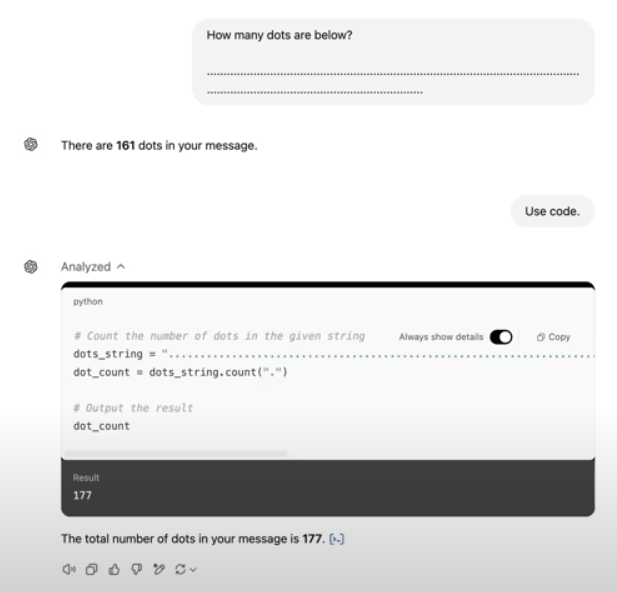
- when it is an mathematical problem you, can have the model create a python program and execute it.
- e.g. “I have 150 cookies and 65 juices to sell. The cookies cost €3 each and I want to make €775 in total. How much do I need to sell the juices for. Use code” OpenAI will actually create a Python program and execute the program iso statistically tryin g to predict the most likely outcome.
- Same for spelling and letter questions (cfr. the famous strawberry question). The underlying reason here lies in the tokenization that LLM models use (they see tokens, not characters). The models are getting better at answering these question correctly but it still safer to let the LLM use tools like code in these cases.
3. Implement Fact-Checking Mechanisms
Train AI to validate sources and recognize uncertainty in its responses.
4. Human Oversight
AI should still be reviewed by human experts in critical applications such as law, medicine, and finance.
5. Use Models Less Prone to Hallucinations
Models with real-time web search capabilities (e.g., GPT-4o with browsing features).
Reasoning-based models, which generally hallucinate less but are not completely immune.
6. Implement User Feedback Loops
Regularly evaluate AI output to detect errors.
Allow users to provide feedback on AI-generated answers to refine future responses.
Why Do Reasoning Models Have Fewer Hallucinations?
Stronger logical consistency – Reasoning models are specifically trained for step-by-step thinking. They often integrate formal logic, symbolic AI, or reinforcement learning, making their output more structured and reliable.
Use of explicit reasoning chains – Unlike generative models that rely on linguistic patterns, reasoning models construct logical argument chains, reducing contradictions and false conclusions.
Ability to backtrack and correct errors – Some reasoning models can evaluate, revise, and refine their own reasoning.
Example: Chain-of-Thought (CoT) prompting forces AI to explain its logic step by step, reducing errors.
Integration of structured knowledge retrieval (RAG) – They access external databases, knowledge graphs, or symbolic reasoning tools, making them less dependent on memory-based text generation.
Why Can Reasoning Models Still Hallucinate?
Incomplete or biased training data – Even reasoning models can hallucinate if they are trained on flawed or biased information.
Reasoning ≠ factual knowledge – A model can logically reason over incorrect assumptions, leading to false conclusions. For example, if the model incorrectly believes “Paris is the capital of Germany,” it may make logically sound but factually incorrect inferences based on that premise.
Complexity of natural language – Reasoning in human language is difficult. Models may struggle with abstract or ambiguous questions and still produce incorrect responses.
Conclusion
AI hallucinations are a natural consequence of how language models function. While they cannot be entirely eliminated, they can be significantly reduced through better training data, external verification, improved prompting techniques, and reasoning-based AI models. As AI technology advances, minimizing hallucinations will be crucial for ensuring reliable and trustworthy AI systems.
References
- Deep Dive into LLMs like ChatGPT by Andrey Karpathy